Nutrition report
What genetic studies say about your nutrient levels, from the DNA file you already have.
Full Human reads your 23andMe, AncestryDNA or MyHeritage raw data on your device and writes a PDF that compares your variants with genome-wide studies of vitamins, minerals, fatty acids and food habits, with gene highlights on lactase, coeliac-linked HLA types, alcohol, caffeine and taste. Every row names its study.
An informational report on how the genetic variants measured in your raw DNA file compare with published genome-wide association studies of nutrient levels and food-related traits. It is not a medical or diagnostic test, does not assess any disease, and gives no diet, supplement or treatment recommendations.
27 nutrient levels and food habits · 24 gene highlights · GWAS Catalog, June 2026 release
Works with files from 23andMe · AncestryDNA · MyHeritage · FamilyTreeDNA · Living DNA · WeGene
01 — What is inside
Six sections, from vitamin levels to taste.
A one-page overview comes first, then one section per topic and three appendices. Every item first states how many of its known variants your file measures.
01
Vitamins
Seven vitamins: your variants compared with genome-wide studies of their blood levels.
- Vitamin A
- Vitamin B6
- Folate (B9)
- Vitamin B12
- Vitamin C
- Vitamin D
- Vitamin E
02
Minerals and iron
Minerals: the same comparison for their blood levels, with iron covered by four related blood measures.
- Calcium
- Magnesium
- Phosphorus
- Iron
- Ferritin
- Transferrin
- Transferrin saturation
- Zinc
- Copper
- Selenium
03
Fatty acids and homocysteine
Omega-3 and omega-6 shares in blood, and homocysteine, a marker of how folate and vitamin B12 are used.
- Omega-3 fatty acids
- DHA
- Omega-6 to omega-3 ratio
- Linoleic acid (omega-6)
- Homocysteine
04
Food and drink habits
What people with similar variants reported drinking and eating in large studies.
- Coffee intake
- Alcohol intake
- Protein intake
- Fat intake
- Carbohydrate intake
05
Food tolerance
Lactase persistence and coeliac-linked HLA types, read as gene highlights.
- Lactase persistence
- Coeliac-linked HLA types
06
Taste and smell
Harmless differences in bitter taste, sweet preference and two smells.
- Bitter taste (TAS2R38)
- Floral smell of beta-ionone (OR5A1)
- Smelling asparagus in urine
- Sweet preference (FGF21)
A1
Nutrients without reliable genetic studies yet
Vitamin B1 · Vitamin B2 · Vitamin B3 · Vitamin B5 · Vitamin B7 · Vitamin K · Sodium · Potassium · Chloride · Iodine · Manganese · Sulfur
A2
Popular nutrition-gene claims we leave out, and why
34 claims other services make, each with the reason and the studies. They are summed up below.
A3
Methods and sources
The GWAS Catalog release, the studies and variants used, the coverage and scoring rules, how DNA strands are handled, and the sources of every gene highlight.
02 — Gene highlights
24 gene highlights on well-studied variants, read one by one.
Some single variants are well enough studied to explain on their own. Each card shows the gene, the rsID, your genotype, what studies found for people with that genotype, its limits, and the PubMed sources with an evidence grade. Most cards sit under the item they belong to; the food tolerance and taste cards have sections of their own.
7 cards touch on medical topics: lactase, coeliac-linked HLA types, HFE iron loading, MTHFR and alcohol breakdown. They describe a genotype and what studies found, carry a 'Not a diagnosis' note, and point to a doctor for symptoms or questions.
Vitamins
- BCO1 (BCMO1)Beta-carotene to vitamin A conversion
- ALPLVitamin B6 blood form (ALPL)
- FUT2FUT2 secretor status and vitamin B12 readings
- TCN2TCN2 and vitamin B12 readings
- SLC23A1 (SVCT1)Vitamin C transporter
- GC / CYP2R1 / DHCR7Vitamin D transport and production genes
- CYP4F2Vitamin E breakdown (CYP4F2)
Minerals and iron
- CASRCalcium set point (CASR)
- HFENot a diagnosisHFE iron-loading variants
- TMPRSS6Iron and the TMPRSS6 gene
- DMGDH / BHMTSelenium and the DMGDH region
Fatty acids and homocysteine
- FADS1 / FADS2Omega-3 and omega-6 conversion (FADS1 and FADS2)
- ELOVL2DHA and the ELOVL2 gene
- MTHFRNot a diagnosisMTHFR C677T, folate and homocysteine
Food and drink habits
- CYP1A1-CYP1A2 / AHRCaffeine level and coffee drinking
- ALDH2Not a diagnosisAlcohol flush
- ADH1B Arg48HisNot a diagnosisAlcohol breakdown
- ADH1B Arg370CysNot a diagnosisAlcohol breakdown, second ADH1B variant
Food tolerance
- LCT / MCM6Not a diagnosisLactase persistence
- HLA-DQA1 / HLA-DQB1Not a diagnosisCoeliac-linked HLA types
Taste and smell
- TAS2R38Bitter taste (TAS2R38)
- OR5A1Floral smell of beta-ionone (OR5A1)
- OR2M7Smelling asparagus in urine
- FGF21Sweet preference (FGF21)
03 — How it works
Read on your device, compared with the average, honest about coverage.
01
Your file stays in your browser
The generator is compiled to WebAssembly and runs in your browser tab. Your raw file is read in memory and the PDF is written on your device; our servers see an account and a credit, never your genotypes.
02
Every row from the GWAS Catalog
Items are built from genome-wide association studies in the NHGRI-EBI GWAS Catalog (June 2026 release). Each variant in a table names its study with a PubMed link, and each gene highlight lists its sources.
03
Compared with the average, not with a target
For each nutrient we use up to 20 of the strongest independent findings in the GWAS Catalog, compare the alleles you carry at each with the average person of European ancestry, and report a slightly higher or lower tendency only when at least a third of those findings, and at least three variants, are measured in your file and your total lies more than one standard deviation from that average, which is the case for about one person in three. A higher level is not better in itself.
04
Coverage first
A consumer chip reads only some of the known variants, so each item first says how many of them your file measures. On the GSA-type chip used by 23andMe v5 and MyHeritage, about 21 of the 27 items reach the coverage needed for a tendency. Vitamin B6, vitamin E and selenium have fewer than three known variants, so their variants are listed without a tendency; any other item the report cannot assess says so rather than guessing.
04 — Sample pages
Six pages from the sample report.
The complete reportNothing is cut: all 56 pages, from the one-page overview through every section to the three appendices. Items that could not be assessed are shown as they come out.
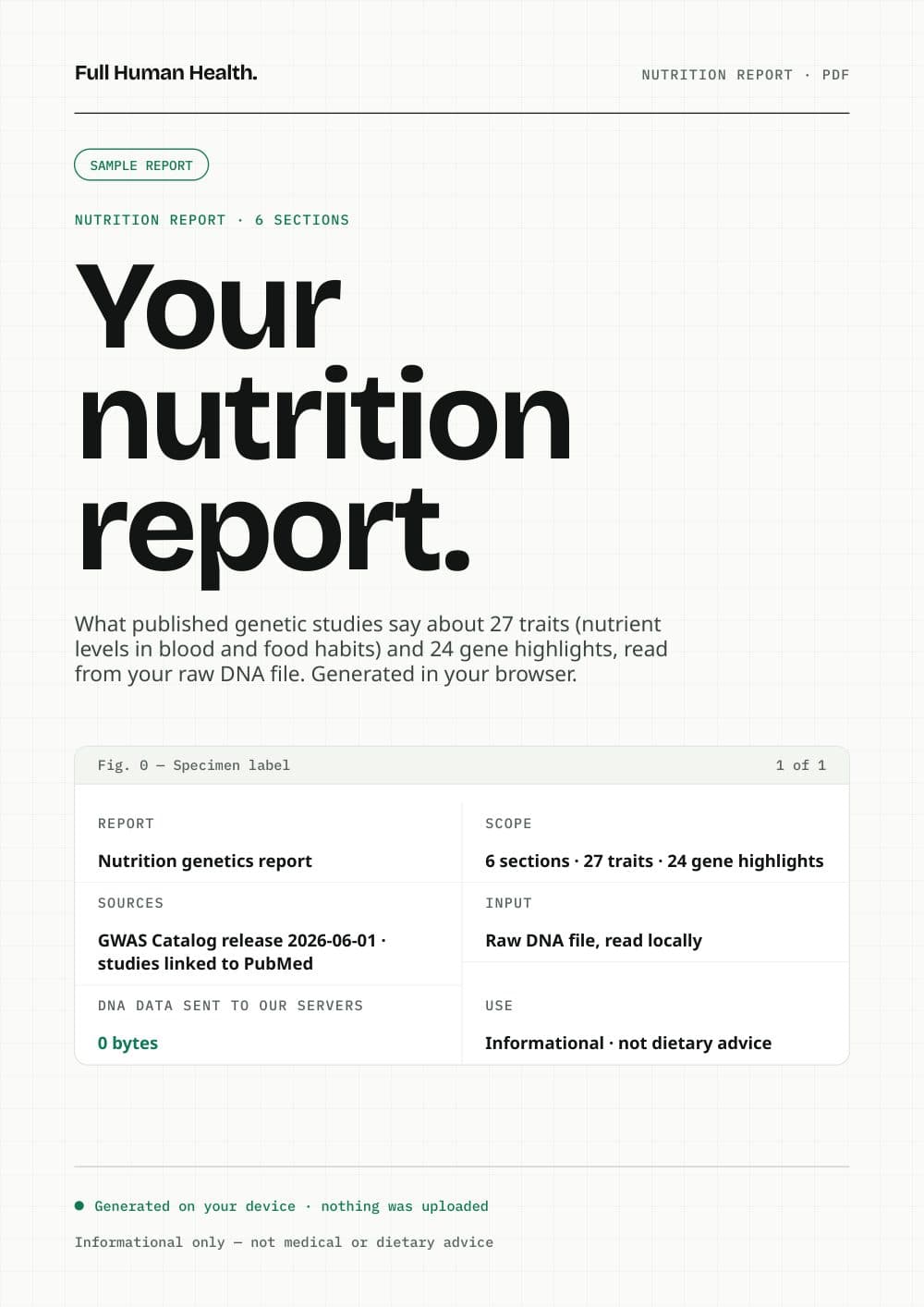
Cover 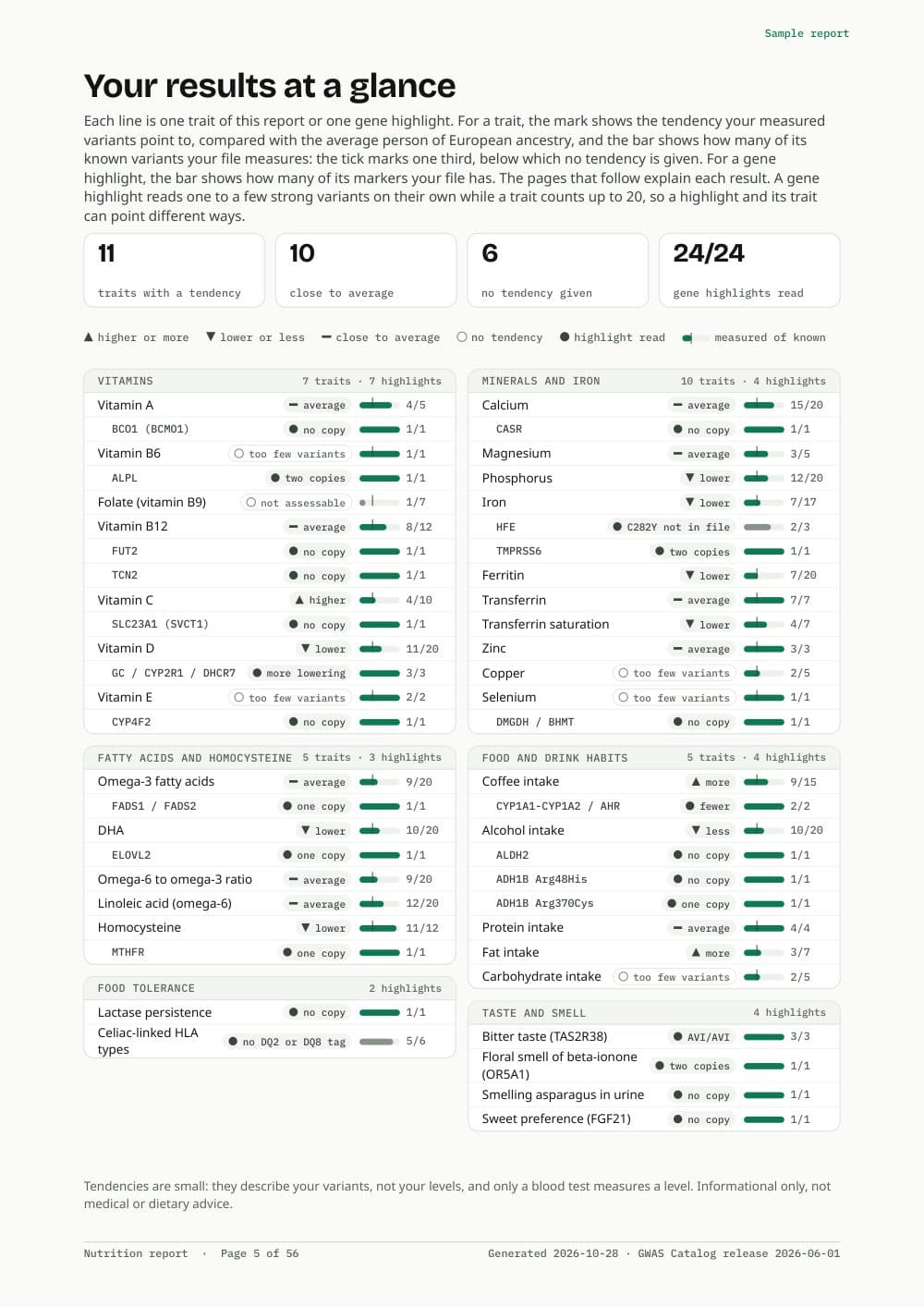
One-page overview of every item and highlight 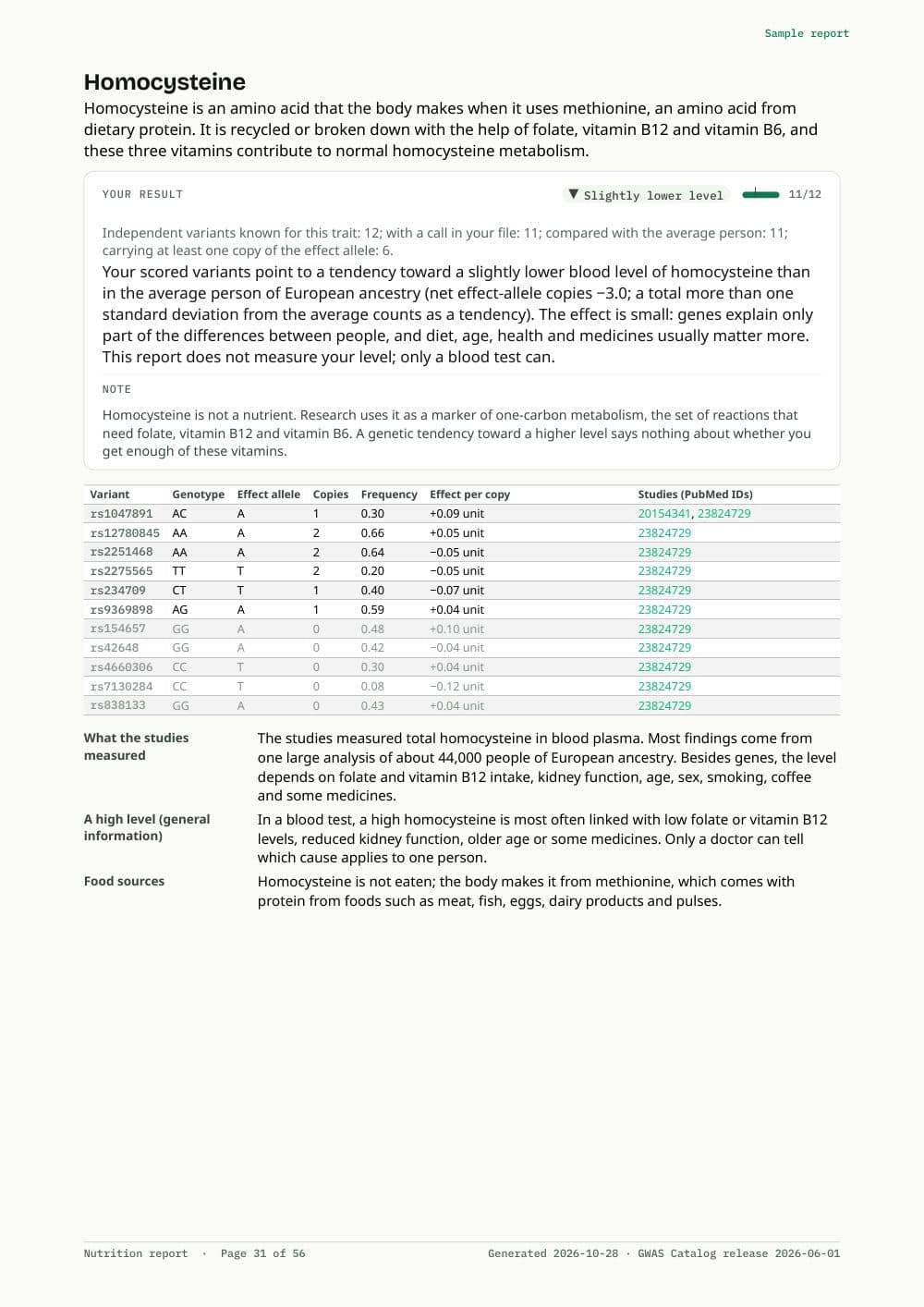
An item: coverage, tendency and the variant table 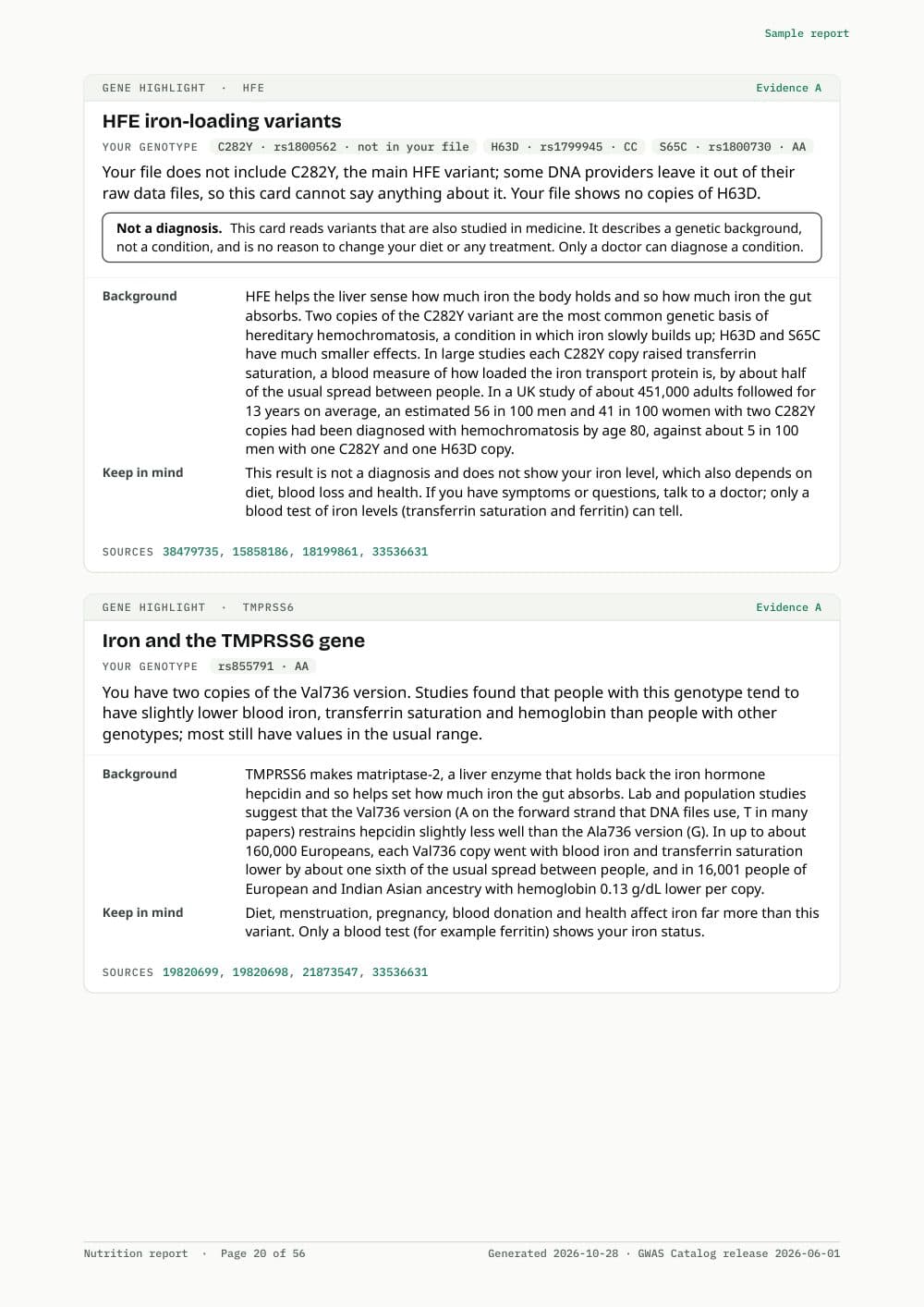
Two gene highlight cards, with genotypes and sources 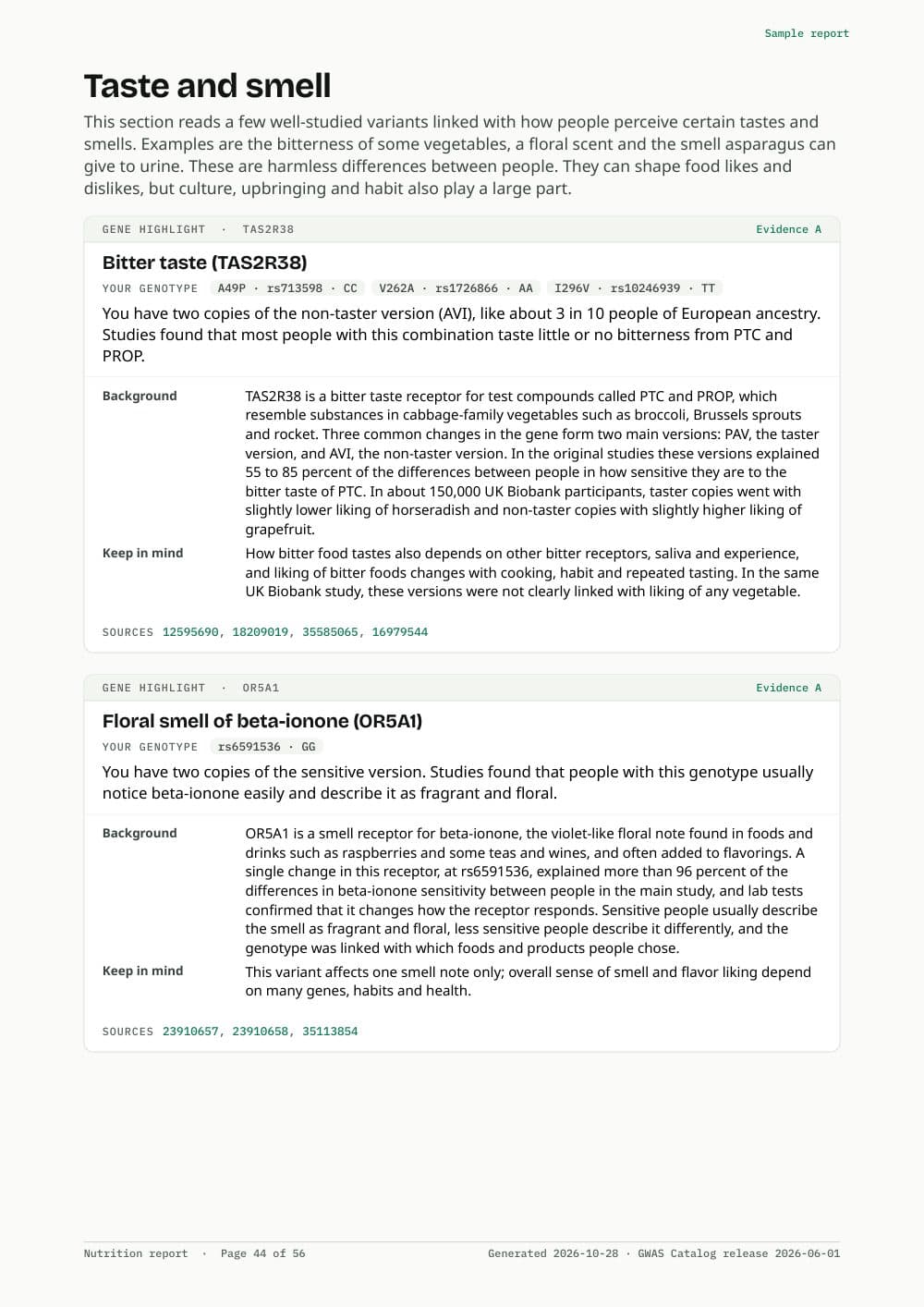
Taste and smell 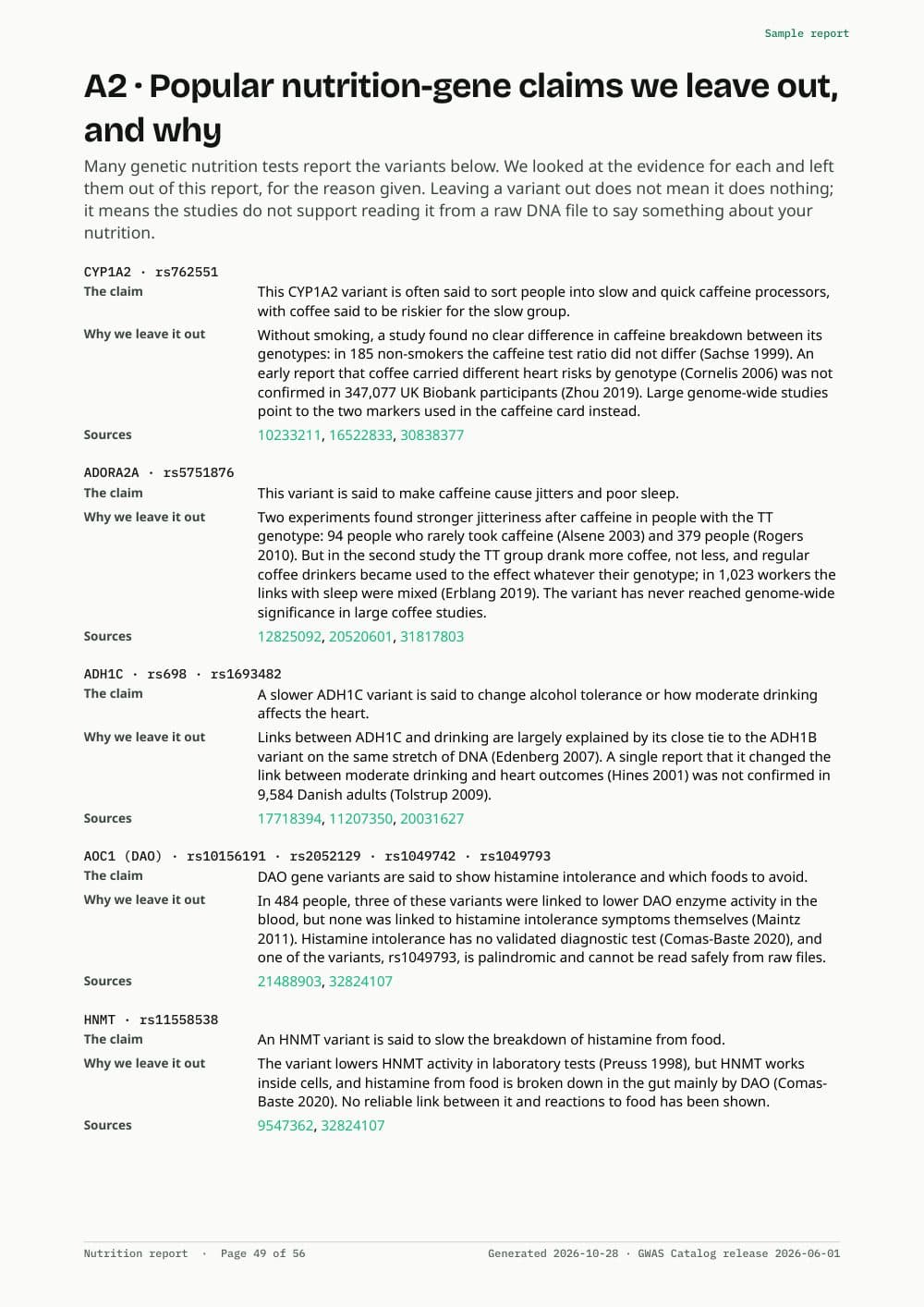
Claims we leave out, and why
What this report is not
Information about your variants, nothing more.
- Not a diagnosis or a medical test. It does not assess any disease, deficiency, intolerance or allergy.
- Not a blood test. It cannot tell your vitamin or mineral levels; only a blood test can.
- No diet plan, no supplement or dose advice, and nothing to buy afterwards.
- It does not tell you how much of a nutrient you need: reference intakes depend on age, sex and life stage, not on these variants.
- Not a substitute for a doctor or a registered dietitian. Genes are one small influence on nutrient levels; diet, sun, age, health and medicines usually matter more.
05 — Left out
Popular nutrition-gene claims we leave out.
Many DNA diet services report variants that large studies did not confirm. The report's appendix lists 34 such claims, each with the reason and the studies. In short:
Caffeine and alcohol 'types'
CYP1A2 · ADORA2A · ADH1C
Large studies did not confirm that these genes sort people into caffeine or alcohol types. The report reads the variants genome-wide studies did find instead: near CYP1A2 and AHR for caffeine, ALDH2 and ADH1B for alcohol.
Intolerances and allergies
AOC1 (DAO) · HNMT · ALDOB · HLA-DQ / HLA-DR · HLA-DPB1
DAO and HNMT variants have not been linked with reactions to food; ALDOB variants are rare and chips often miscall them; the HLA marker for peanut allergy is carried by about half of Europeans, nearly all of them not allergic, and the wheat allergy findings come from two specific groups in Japan; and no marker is known for gluten sensitivity without coeliac disease.
Methylation and B-vitamin needs
MTHFR A1298C · MTR · MTRR · SLC19A1 · TCN2 776C>G · PEMT · CHDH · BHMT · MTHFD1
Genome-wide studies of homocysteine, folate and vitamin B12 in tens of thousands of people found no separate effect of these variants, or only a very small one, and the choline claims rest on two small feeding studies. Vitamin needs are set by age, sex and life stage.
Vitamin and mineral needs
VDR · BCO1 R267S / A379V · SLC30A8 · GPX1
Genome-wide studies of vitamin D, beta-carotene, zinc and selenium levels point to other genes or other markers, which the report uses instead. Nutrient needs are set by age, sex and life stage, not by these variants.
Diet type and weight loss
FTO · APOA2 · APOA5 · PPARG · TCF7L2 · MC4R · APOE
In trials, weight loss was the same whatever the FTO genotype, and no trial has shown that advice based on the others works better than general advice. APOE is studied mainly in connection with inherited disease, not nutrition, and is not shown.
Sweet tooth, fat taste and salt
CD36 · TAS1R2 · TAS1R3 · SLC2A2 · CA6 · OR6A2 · ACE · AGT
The sweet-receptor, GLUT2, fat-taste, gustin and coriander findings come from small or single studies that larger ones did not confirm. ACE and AGT variants were not linked with how blood pressure responds to salt.
Detox and starch genes
AMY1 · GSTM1 · GSTT1
These genes vary by whole-gene deletions or copy number, which a SNP-based DNA file cannot read reliably.
Questions
Nutrition report: common questions
- Is this a DNA diet test?
- No. Nothing new is tested: the report reads the raw data file you already have from 23andMe, AncestryDNA, MyHeritage, FamilyTreeDNA, Living DNA or WeGene and compares it with published studies. It gives no diet type, meal plan or supplement advice; in trials, advice based on genotypes did not work better than general advice.
- Will it tell me which vitamins or supplements I need?
- No. Nutrient needs are set by age, sex, life stage and health, not by these variants, and the general reference intakes apply to you as to everyone. The report gives no supplement or dose advice; questions about supplements belong with a doctor or pharmacist.
- Can it tell me if I am lactose intolerant or have coeliac disease?
- No. The lactase card reads rs4988235, the variant that in people of European ancestry goes with keeping lactase active in adulthood, and many people without it have no symptoms with usual servings of milk. The HLA card reads the types most people with coeliac disease carry; about 1 in 3 people of European ancestry carry one of them, and only about 3 in 100 carriers develop coeliac disease. Only a doctor can diagnose either, with tests such as a breath test or a blood test for coeliac antibodies.
- Why does an item say 'not assessable'?
- A consumer chip reads a few hundred thousand positions, so a file often lacks some of an item's known variants. An item gets a tendency only when at least a third of its known variants, and at least three, are measured; otherwise the report says so instead of guessing. Vitamin B6, vitamin E and selenium have fewer than three known variants, so no file gets a tendency for them; their variants are listed without one. 'Not assessable' says nothing about your level.
- Does it look at MTHFR?
- It reads one MTHFR variant, C677T (rs1801133), in a gene highlight next to homocysteine: your genotype, what large studies found for folate and homocysteine, and the medical genetics position that MTHFR genotyping has little medical use. A1298C is not reported, for reasons the appendix gives, and there is no methylation or supplement advice.
- How is it different from the health report?
- It is a separate PDF and costs a separate credit. The health report gives tendencies for the odds of conditions; the nutrition report covers nutrient levels in blood, food and drink habits, food tolerance and taste. Both use the same GWAS Catalog release and are generated in your browser. Coeliac disease appears in both from different angles: the health report combines its GWAS variants, the nutrition report reads the HLA types, so the two pages can read differently.
- Which files and languages work?
- The raw data export (.txt, .csv or .zip) from 23andMe, AncestryDNA, MyHeritage, FamilyTreeDNA, Living DNA or WeGene. The PDF can be generated in English, German or French. Chips differ, so the free file checker shows how many nutrition catalog variants your file holds before you buy.
- Should I show it to a doctor or a dietitian?
- You can. Your genes are only one small influence on your nutrient levels. If you have symptoms or questions about your diet, talk to a doctor or a registered dietitian; a blood test is the only way to know your level.
One credit per PDF
The nutrition report, from the file you already have.
Generated in your browser in English, German or French. No subscription; a credit is used only once the PDF is written, and failed generations are refunded.
Informational · not dietary or medical advice
Read next
- How to Check MTHFR in Your 23andMe Raw Data, and What the Evidence Supports
- Coeliac Disease Genes in Your Raw DNA Data: HLA-DQ2.5 (rs2187668), DQ8 (rs7454108) and What They Can't Tell You
- What Can You Do With Your Raw DNA Data? 12 Uses, and Which Ones Upload Your File
- How to Read Your Raw DNA Data File (23andMe, AncestryDNA, MyHeritage): rsIDs, Genotypes and What They Mean
- The GWAS Catalog, Explained: What It Is and How It Becomes Your DNA Health Report
Other pages
Sources
- NHGRI-EBI GWAS Catalog (checked 28 October 2026)
- EFSA: Dietary Reference Values for nutrients, summary report (2017) (checked 28 October 2026)
- Hickey et al., ACMG practice guideline: lack of evidence for MTHFR polymorphism testing (2013) (checked 28 October 2026)
- Livingstone et al., FTO genotype and weight loss: meta-analysis of eight randomised trials (BMJ 2016) (checked 28 October 2026)
- Celis-Morales et al., the Food4Me European randomised controlled trial (Int J Epidemiol 2017) (checked 28 October 2026)
The nutrition report is informational. It is not a medical or diagnostic test and gives no diet, supplement or treatment recommendations. Full Human Health is not affiliated with the DNA testing companies named on this page.